

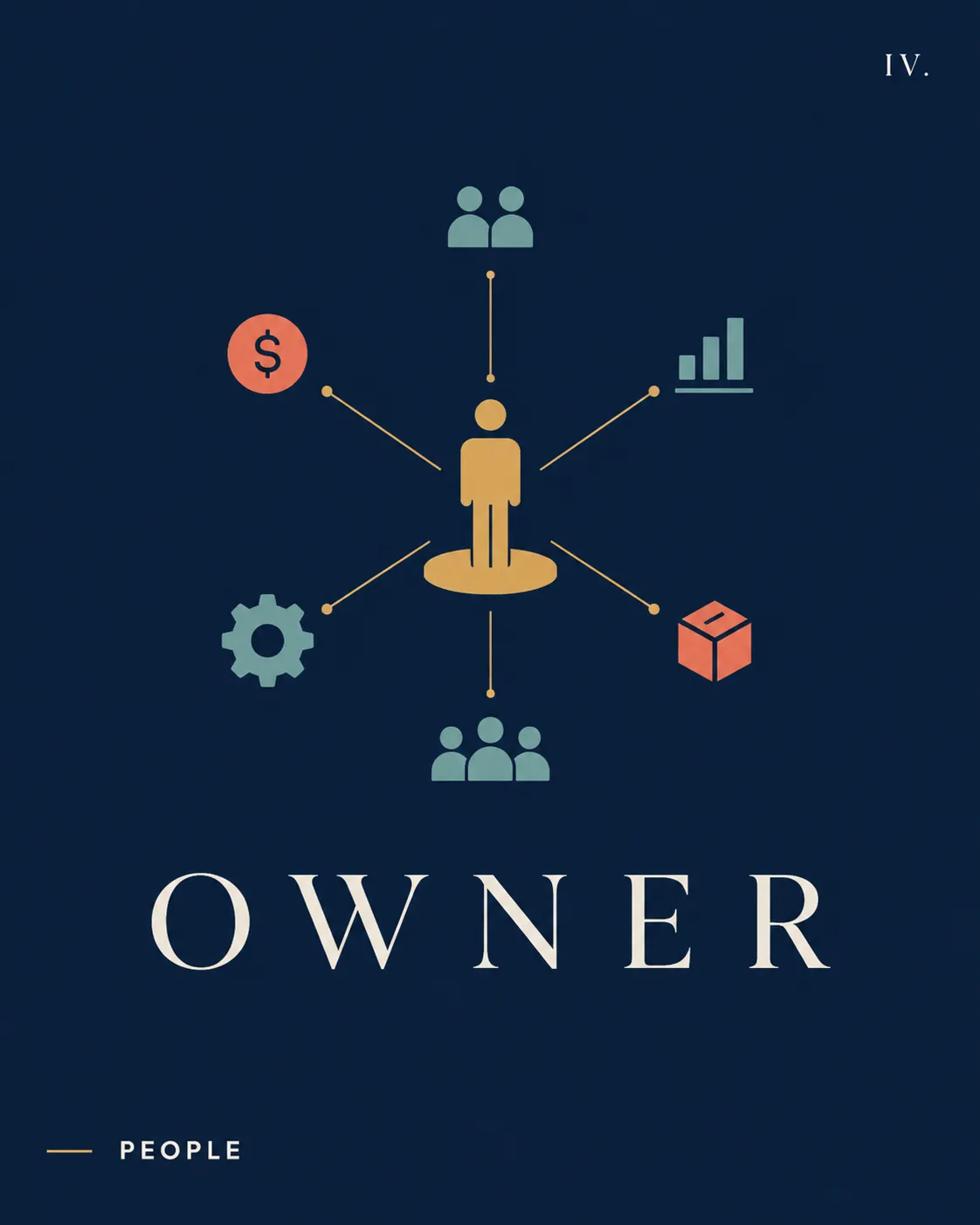
At the beginning, the owner is supposed to be everywhere. They know the customers. They know the field. They know which jobs are worth taking and which ones carry poison in the walls. They know which technician can be trusted, which manager is not ready, which number looks fine but feels wrong.
That instinct built the business. Then, quietly, it becomes the ceiling.
The company grows. More trucks. More people. More systems. More branches. More meetings. More reports. But the important decisions still find the owner. A customer exception. A pricing question. A technician problem. A manager who needs permission. A job that feels off. A promise made three years ago that only one person remembers.
The org chart says the business has structure. The week says otherwise. The owner is still the operating system.
That is not a moral failure. It is not ego by default. In a lot of founder-led trades businesses, the owner stayed in the middle because staying in the middle was how the company survived. They were the escalation path, the memory, the judge, the customer historian, the margin conscience, the weather vane.
But a business cannot scale cleanly if every hard thing still has to pass through one person’s chest.
The work is translation, not removal
At some point, the work is translation. Not removal. Translation.
What does the owner know that the business has never written down? What decisions are still theirs because nobody else has the criteria? Which customers are being handled by memory instead of process? Which managers are waiting because empowerment was promised but not actually given? Which risks does the owner see before the report does?
That knowledge has to move. Into cadence. Into decision rights. Into role clarity. Into the operating record. Into people who can carry pieces of the judgment without pretending to become the founder.
The discipline of moving authority out of one person and into a structure is not new. Teachers have been working on it for a century.
Freedom inside a structure
Maria Montessori wrote that the greatest sign of success for a teacher is being able to say the children are now working as if she did not exist. That sentence belongs in business more than half the leadership books on the shelf.
A team that only works when the owner pushes does not have a system. It has a person holding the system together. At some stage of growth, that breaks.
The answer is not absence. It is not stepping back and hoping people figure it out. The Montessori idea is more disciplined than that. The teacher prepares the environment, observes the work, gives the right amount of guidance, and then lets the student build real capacity. Freedom exists, but it exists inside a structure.
A good operator does not disappear. A good operator builds the conditions that make constant intervention unnecessary. Does the team know what good looks like? Do they know who owns which decision? Do they have the tools, information, and authority to move without waiting? Do the meetings create clarity or just more talking?
Once that exists, the leader’s job changes. It becomes less about directing every move and more about observing the system. Where does the team hesitate? Where does information get stuck? Which person is carrying more than their title? Step in too early, and people never build judgment. Step in too late, and the business absorbs avoidable damage. The skill is timing.
The goal is not to make the owner disappear. The goal is to stop making the business borrow the owner’s nervous system to get through the week.
If an owner or key leader is stepping back, When to Call Us covers how a study captures the working knowledge they carry.