

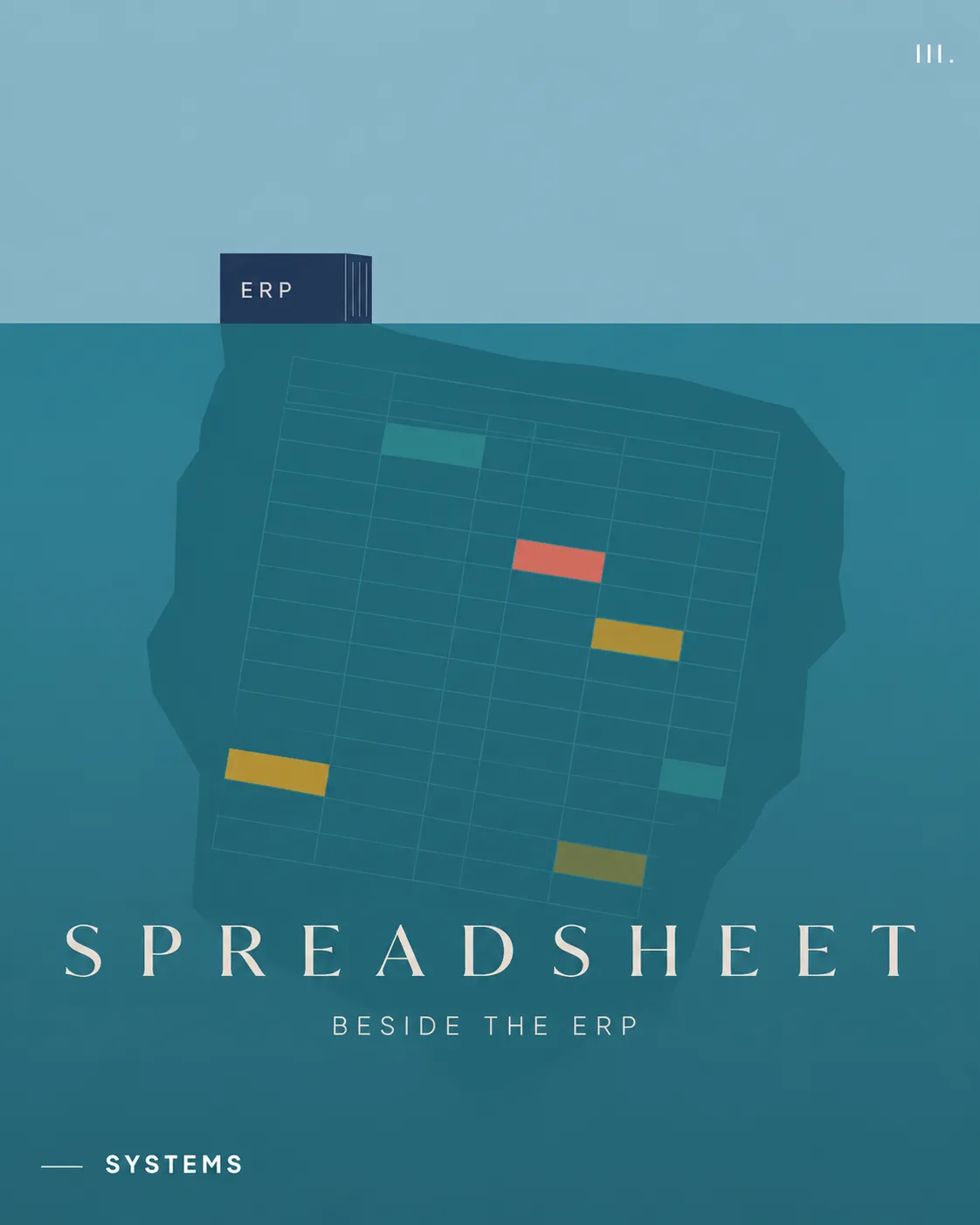
The spreadsheet is never really beside the ERP. It is under it. Holding up the places the system never learned to carry weight.
Every growing trades business has one. Usually more than one. Dispatch has a spreadsheet. Finance has a spreadsheet. The branch manager has a spreadsheet. The project manager has a spreadsheet. The owner has the one nobody else is allowed to touch.
Everyone knows they are not supposed to need them. Everyone uses them anyway.
The usual explanation is resistance. People do not like change. The team will not adopt the system. The old habits are too strong. Sometimes that is true. More often, the spreadsheet is telling the truth before the system can.
It exists because somebody needed to make a decision and the official process did not help. The report was too late. The field was wrong. The data was buried. The workflow was built for accounting but the decision belonged to operations. The system had the information, but not in a way the business could use before the day got away from them.
So someone made a file. That file became useful. Useful became trusted. Trusted became dangerous.
Not because spreadsheets are evil. They are not. A spreadsheet is often the first honest map of a broken process. It shows what the system is not showing, what the team does not trust, and where the work keeps leaking out of the official path.
The mistake is pretending the spreadsheet is only a bad habit. The other mistake is killing it too early. If you take away the workaround before you understand the work it is doing, the business will build another one. Usually faster, uglier, and farther from view.
Every workaround has a reason
The spreadsheet is one kind of workaround. There are others. Someone created a side process because the system was too slow. Someone kept the customer list outside the CRM because the official data could not be trusted. Someone started texting the field because the dispatch process broke under pressure.
Most workarounds do not begin as laziness or rebellion. They begin as survival. The customer needed an answer. The job needed to move. The branch needed visibility. The owner needed a number before the system could produce one. So the team solved the problem. Good.
Then the workaround stayed. That is where it gets dangerous. The side conversation becomes the real approval path. The person who built the workaround becomes the only person who understands it. The official system becomes less trusted because the workaround is faster.
Now the business has two processes: the one it says it uses and the one that actually gets the work done. That split is expensive. It creates hidden labor. It creates dependency on people who may not even know they are carrying risk. It makes training harder, integration harder, scaling harder.
The question to ask first
The right question is not, why are they still using a spreadsheet. The right question is, what does this spreadsheet know that the system does not?
Who uses it. What decision does it support. What happens if it disappears tomorrow. Why does the team trust it. Where does the ERP lose the thread.
Some workarounds should be killed. Some should be formalized. Some should become system requirements. Some should be left alone until the business has enough capacity to absorb the change. But none should be invisible.
A source of truth is not created by saying the words. It is created when the people doing the work can trust the system enough to stop building shelter beside it.
Until then, the spreadsheet stays. Not as a file. As a warning.
If you are planning a systems change, When to Call Us covers how a study maps the process people actually use.